For parents, teachers & librarians

Human body books for kids — and what to do with them

Anatomy for early readers, written by a practicing ER doctor. Below: a free 16-term glossary, six discussion questions, and three hands-on experiments that work at a kitchen table or in front of a class of twenty-eight.

Why anatomy, why now

Six-year-olds can absolutely say “tricuspid”

Children’s books about the human body tend to split into two camps. One camp is cheerful and vague — the heart is a pump, the end. The other is a labeled diagram with a reading level of about fourteen.

The Micro Missions™ Series sits in the gap. It keeps the real vocabulary — atrium, ventricle, hemoglobin, alveoli — and hands it to a child inside a story with stakes. That combination does two useful things at once: it builds the science vocabulary early, and it makes the body feel like somewhere knowable rather than somewhere frightening.

Which matters more than it sounds. A lot of children’s anxiety about their own bodies is really just an information gap. Close the gap and a racing heartbeat stops being alarming and starts being interesting.
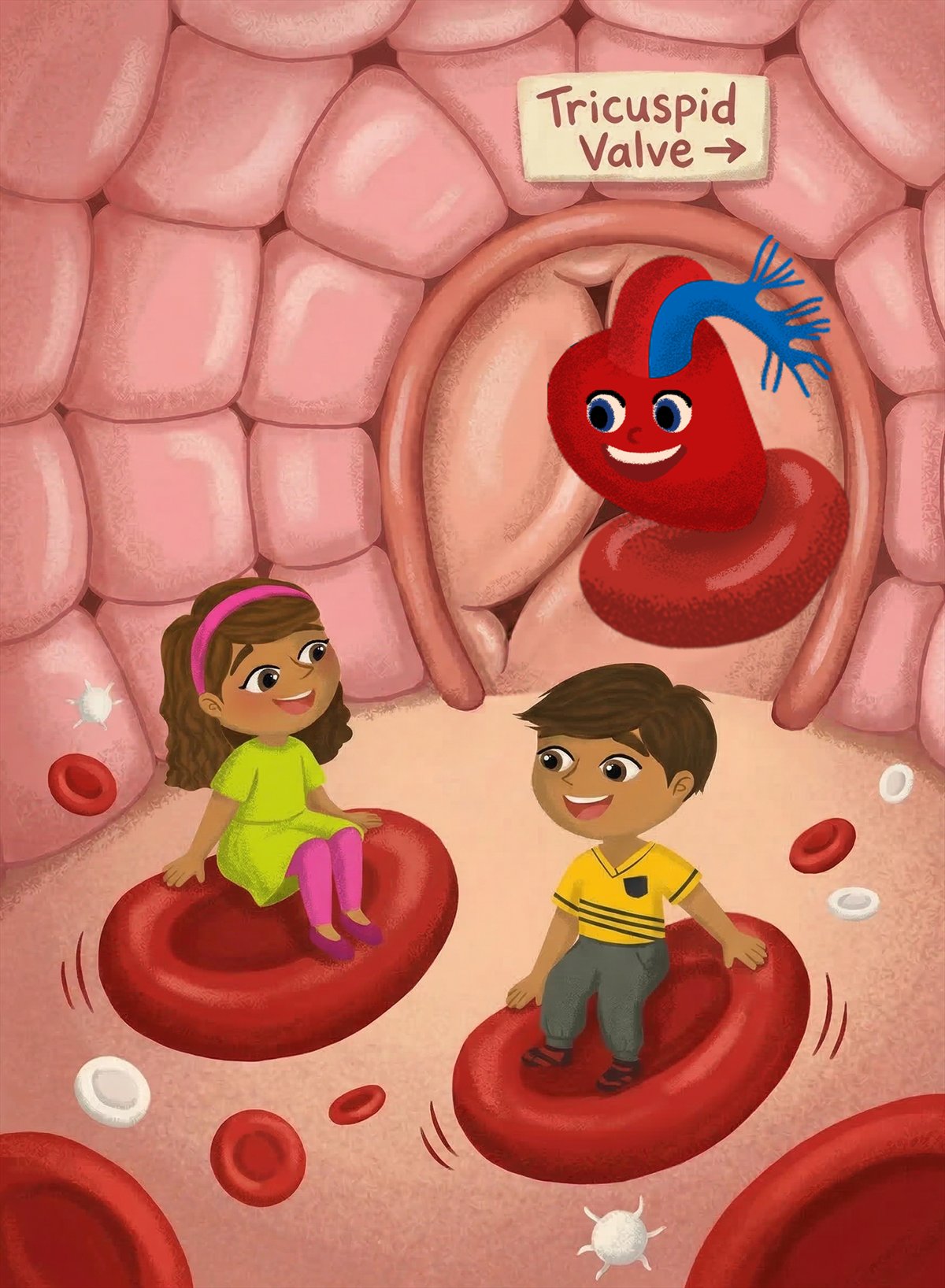
Interior illustration: two children sit on red blood cells inside the right atrium of a heart, under a wooden signpost that reads Tricuspid Valve.

Free downloads

Two printables from the back of Book 1

Free, no email needed. Straight from the back of The Heartbeat Mystery, laid out on letter-size paper.

Talk About It — discussion questions

The six questions from the book, for talking over with a grown-up, a teacher, or a friend after reading. No wrong answers, just interesting ones.

Download the PDF

Big Words from Heartland — glossary

All 16 words from the book’s glossary, with pronunciations, exactly as they appear in the back of the book.

Download the PDF

Big words from Heartland

The full 16-term glossary

Straight from the back of Book 1 — sixteen terms with pronunciations, most of them met inside the story before a child ever reaches the definition.

Alveoli (al-VEE-oh-lye)
Tiny balloon-like sacs in your lungs where oxygen enters your blood. You have about 500 million of them!
Aortic valve (ay-OR-tik)
The valve that lets blood out of your left ventricle and into the aorta. When it slams shut, you hear the DUB in the lub-DUB!
Aorta (ay-OR-tah)
The biggest blood vessel in your body, carrying oxygen-rich blood from your heart out to the rest of you.
Atrium (AY-tree-um)
One of the two upper rooms of your heart. The right atrium collects blood from your body; the left atrium collects blood from your lungs.
Capillary (KAP-ih-lair-ee)
The tiniest blood vessels in your body—so small that red blood cells line up single-file to squeeze through.
Carbon dioxide (KAR-bun dye-OX-ide)
A gas your body makes when cells use up oxygen. You breathe it out every time you exhale.
Hemoglobin (HEE-moh-glow-bin)
The part of a red blood cell that grabs onto oxygen and carries it. Each red blood cell holds about 300 million of them!
Mitral valve (MY-truhl)
The two-door valve between your left atrium and left ventricle. It makes sure blood flows one direction only—no backtracking!
Oxygen (OX-ih-jen)
The gas your body needs to make energy. You take it in every time you breathe in.
Pulmonary valve (PUL-muh-nair-ee)
The valve that lets blood out of your right ventricle and on its way to your lungs.
Red blood cell
The donut-shaped (without the hole!) cells that carry oxygen everywhere. You have about 25 trillion—that’s why the river looked so crowded with boats.
ROY G BIV
An easy way to remember the seven colors of the rainbow: Red, Orange, Yellow, Green, Blue, Indigo, Violet.
Tricuspid valve (try-KUSS-pid)
The three-door valve between your right atrium and right ventricle. Tri- means three.
Vena cava (VEE-nah KAY-vah)
The big vein that brings used blood back to your right atrium. The inferior vena cava (IVC) comes from below; the superior vena cava comes from above.
Ventricle (VEN-trih-kuhl)
One of the two lower rooms of your heart. They squeeze hard to push blood out—the left ventricle’s walls are three times thicker than any other chamber!
White blood cell
A fighter cell that protects your body from germs—those are the spiky white things floating in the blood in the story.

Talk about it

Six questions for after the last page

Half science, half feelings — because in this series they are not separate subjects.

  1. If you could ride a red blood cell boat anywhere inside your body, where would you go—and what would you hope to see? What might you find that surprises you?
  2. Haley was lost without her blanky, Hearty. What’s the thing that helps your heart feel calm when you’re scared or sad—a stuffy, a song, a person, a place? And what about your grown-up: what calms theirs?
  3. Tyler started the story hiding behind Tia, but by the end he was the brave one giving Haley a hug. When was a time you felt scared but did something brave anyway?
  4. Tyler and Tia are very different—Tyler likes to race and be first, while Tia likes to take her time and notice things. Are you more like Tyler or more like Tia? What about the person reading with you?
  5. At the end, Tyler says, “Teamwork makes the blood work!” Can you think of a time you and a friend, sibling, or classmate did something better together than you could have alone?
  6. Your body has secrets you can’t see—like 25 trillion red blood cells doing their job every second. What’s something about your body that you’ve always wondered about? Who could you ask?

Try this today

Three experiments, no equipment budget

1. Find your own pulse

Two fingers on the inside of the wrist, just below the thumb. Count for fifteen seconds. Now run in place for thirty seconds and count again. The number goes up because the heart is working harder to get oxygen to busy muscles — the book’s “Did You Know?” page suggests trying this too.

2. Be a lung with a balloon

Haley’s explanation in Book 1 is exactly this: “The lungs are like a balloon. When you breathe in, the balloon expands. When you breathe out, the balloon shrinks.” Hand out balloons and let the class be the lungs — one big breath in, one slow breath out, and ask what had to move to make that happen.

3. Run the circuit

Chalk four chambers on the playground, label the valves, and have the class be red blood cells. One direction only. Anyone caught backtracking means a faulty valve.

Common questions

Is this the right book for my kid or my class?

What age is it actually for?

Ages 6–10, roughly grades 1–4. Confident readers of about eight and up can take it solo; younger readers can take it as a read-aloud, a chapter at a time. The chapters are short, and every few pages there is a full-page illustration to talk about.

Where does it fit in a classroom unit?

It pairs naturally with elementary units on the human body, the circulatory system, and structure and function in living things — typically somewhere in grades 1–4.

Is any of it scary?

No. Nothing gruesome, and nobody in the story gets hurt — the tension is a lost blanky and a sad heart. The back matter does talk about health: heart murmurs, anemia, congenital heart conditions and chest twinges. And if a chest ever hurts or doesn’t feel right, the book tells kids to tell someone who loves them.

Is the science really accurate?

Yes, and that is the point of the whole series. It is written by a practicing emergency physician. Blood travels the correct route, the valves are in the right places with their real names, and the numbers are real numbers. What gets simplified is the sentence, never the fact.

When can I buy it?

Soon — the book is finished and printed, and the retail date is being set. There are deliberately no buy buttons on this site yet, because sending you somewhere that doesn’t exist would be rude. Join the launch list and you will hear on day one.